General Information
Nahiya (Subdistrict)
Şera
Also Known As
Al-Deeb Al-Kabir, Gurguhê, El-Dîb el-Kebîr, Qurt Qalaq Large, Qurtqulaq, Qurtqulaqê mezin, Qurtulaqa Mezin, الديب (AR translation), الذئب الكبير, قورت قولاق كبير, قورتقلق فوقاني
Tribes
Ecîl, Efadile, Şikakan, Şikêk
Families, Clans, etc.
Bekû, Elû, Evdo Miqdad, Evdo Reşo, Evdê Reşê, Evdûnê, Hemo Betal, Menan Mela Elî, Mirad Omer, Mirsel, Mislimlêro, Mistefa Xelîl, Mistixelo, Mûskê, Omer, Qebes, Têkliyê, Walî, Welî, Xelîl Îbrahîm Omer, Îbo Ebdîn, Şebab Elî, Şêx, Şêx Ehmed Ecac, Şêxû
Photos
Basic Information about Qurtqulaqê Mezin
Source: Ax û Welat
Etymology: Originally Gurguhê (Wolf's Ear) because wolves gathered at the springs and did not hide their ears; changed to Qurtqulaq by Ottomans.
Old Names: Gurguhê
Foundation Date/Period: Pre Ottoman era
Number of Caves: 2
Springs: Kaniya Şurqût, Binitirba, Kaniya Qurtqulaqê, Kaniya Sork
Hills: Çiyayê Kurtikê, Qeredepê
Shrines: Evdilqadir, Sem'ûn
Ruins: Xirêbe, Hafê Avê
Trees: Darê Çemê
Wells: Bîra Menên, Bîra Gund
Other Landmarks: Kûçê Gura, Geliyê Rêz, Geliyê Kaniyê, Geliyê Zûxur, Geliyê Mişmîşa, Gaza Hewîşê, Meşalê, Qestela Kîşikê, Stasyona Qurtqulaqê
Summaries
I. Summary from TirejAfrin Site (English) of Qurtqulaqê Mezin
Source: https://www.tirejafrin.com/site/kura%20afrin%20%20sheran%20-%20qort%20qolaq%20k.htm
It is stated in the book Çiyayê Kurmênc / Efrîn / A Geographical Study: Qurtqulaq, Qurt Qulaq, Al-Deeb:
Qurtqulaq: A Turkish word meaning "Wolf's Ear" (Qurt = Wolf, Qulaq = Ear). The Arabized name is an inaccurate translation of the Turkish meaning. They are two separate villages: Qurtqulaqa Mezin / Big Qurtqulaq / Al-Deeb Al-Kabir /2549 inhabitants, 5km, 380m/: A medium-sized village located on the eastern bank of Çemê Efrînê (Afrin River).
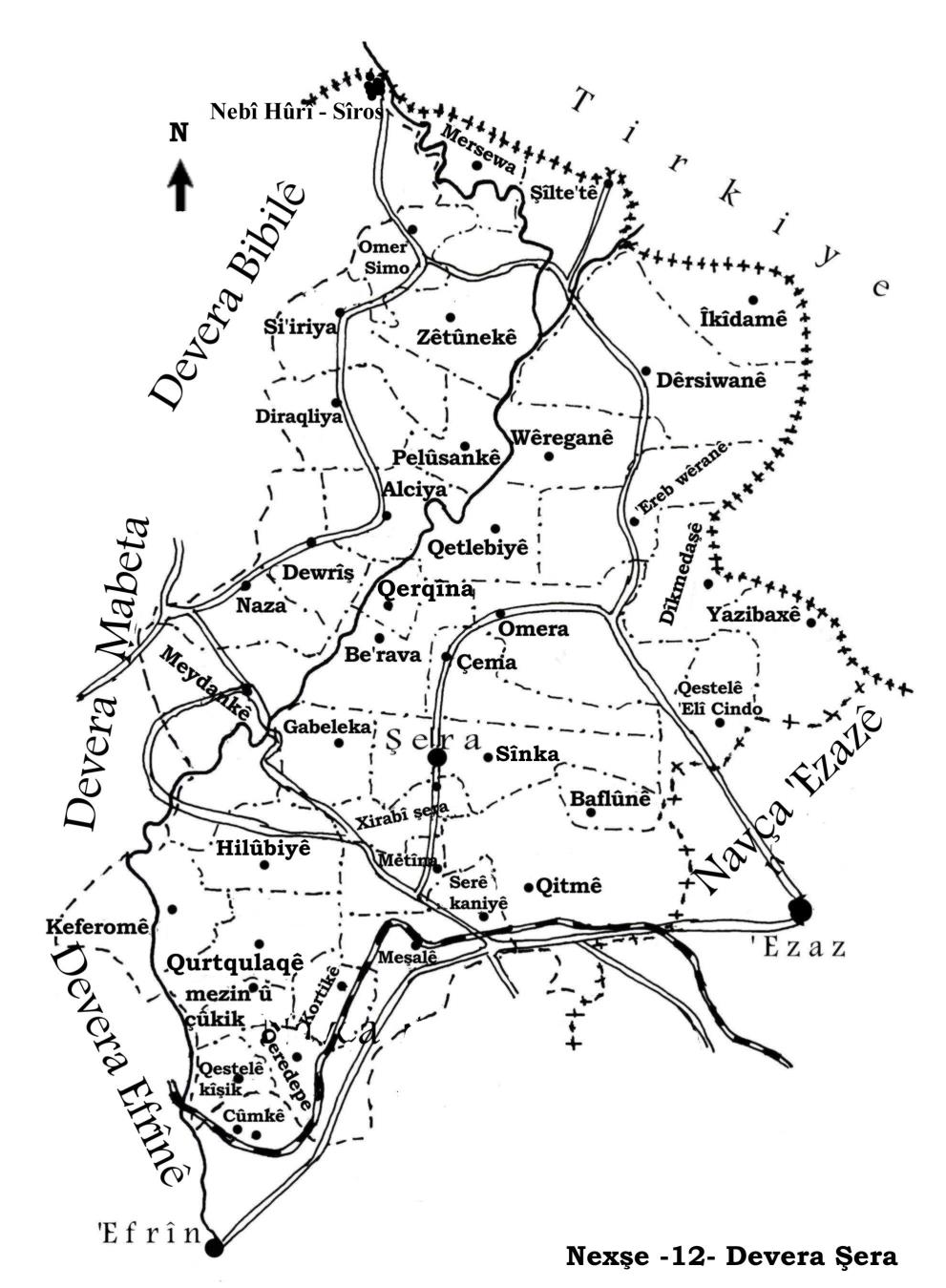
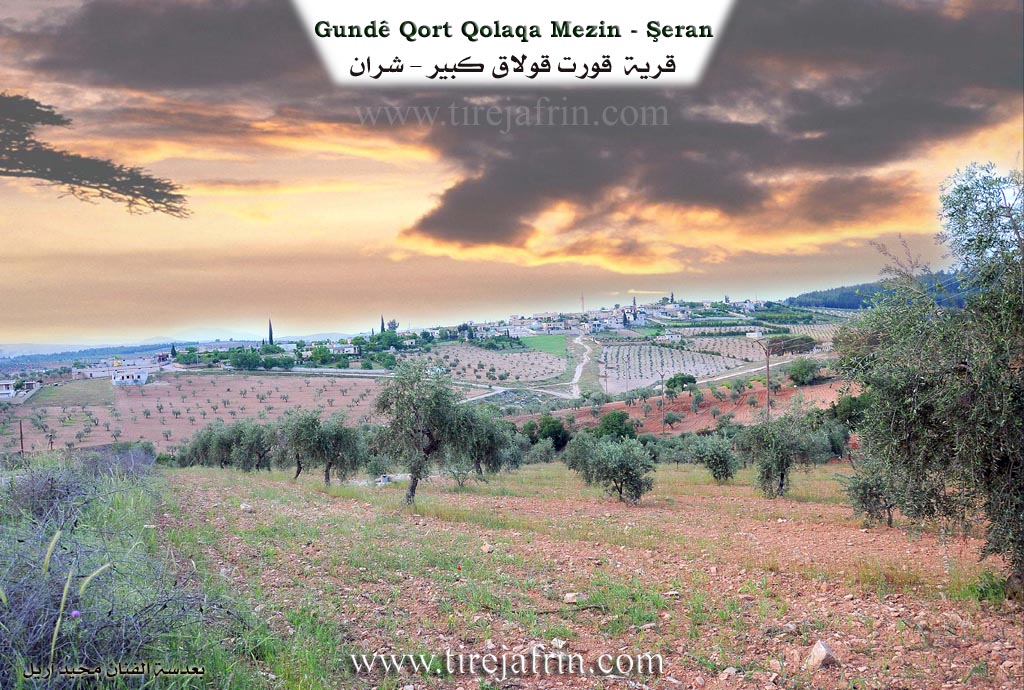
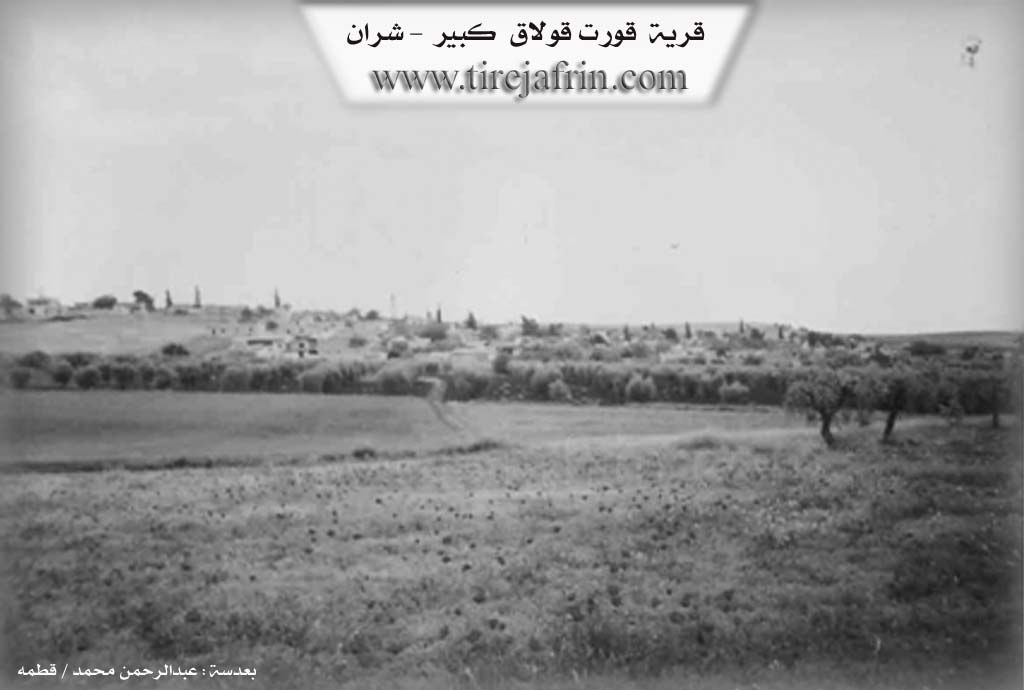
It is stated in the book Efrîn... Her River and Her Green Hills: Qurtqulaqa Mezin is a village located in Çiyayê Kurmênc following the subdistrict of Şeran villages, Efrîn region, Heleb governorate (2478 inhabitants). It is a large village situated on a mountain slope, with a wide plain in front of it extending to the course of the Çemê Efrînê valley.
It is bordered on the north by a slope, a valley, and mountainous highlands planted with olive trees and the village of Hulûbiyê Biçûk. It is bordered on the south by a valley and the village of Qurtqulaqa Biçûk. It is bordered on the east by a mountain chain planted with olive and forest trees, valleys, the village of Meşelê, and the village of Kortik. It is bordered on the west by a slope, a wide agricultural plain planted with olive trees, the nearby valley of the Çemê Efrînê course, the village of Kefer Rûm, and the train station heading towards Turkey.
It is about 6km away from the city of Efrîn towards the northeast of Efrîn. The number of its houses is 150 houses, and the age of the village is about 400 years. Its old dwellings are made of stone and mud with wooden roofs, and the modern ones are of stone and cement. An electricity network is available, as well as drinking water from artesian wells from water collection pools, a primary school, and a modern mosque.
A paved road coming from Meşelê, the Riya Heleb-Efrîn (Heleb-Efrîn road), serves the village and passes through the middle of it to Qurtqulaqa Biçûk and Kefer Rûm. The residents work in the cultivation of olives, vines, and vegetables due to its presence near the course of Çemê Efrînê. It is a beautiful village in terms of its location and is surrounded by olive trees, forest trees, and walnuts. There is a modern olive press in it, and it is an old village in the Şeran subdistrict.
Village Mukhtar: Mihemed Miqdad Omer
Sources of Information:
- Book: جبل الكرد (عفرين) دراسة جغرافية Çiyayê Kurmênc (Efrîn): A Geographical Study by د. محمد عبدو علي Dr. Mihemed Ebdo Elî.
- Book: عفرين .... نهرها وروابيها الخضراء Efrîn... Her River and Her Green Hills by عبدالرحمن محمد Ebdulrehman Mihemed from the village of Qetme.
- Studies of Navenda Tirej Soft / Ebdulrehman Hacî Osman.
- Some residents of the villages.
Preparation and execution: Manager of Tirej Efrîn website: Ebdulrehman Hacî Osman 20/12/2013
II. Summary of Qurtqulaqê Mezin from Ax û Welat
Source: https://www.youtube.com/watch?v=9Ljg9EW-eLY
The village of Qurtqulaq, formally known as Qurtqulaqa Mezin, is a historic settlement located in the Şera district of the Efrîn region. Its history is deeply rooted in the pre Ottoman era, with its original Kurdish name being Gurguhê, which translates to "Wolf's Ear." Elders explain that this name arose because the area was once heavily populated by wolves that would gather at the springs without hiding their ears. During the Ottoman occupation, the name was translated to Qurtqulaq, and later, the Baathist regime attempted to Arabize it to El Dîb El Kebîr. Despite these administrative changes, the local population retains the memory of its original identity.
The origins of the current settlement retrace to an earlier site called Xirêbe, also known as Hafê Avê, located to the west. The residents eventually migrated to the current location, with the Mistixelo family, a branch of the Şikêk tribe, being the first to settle. They initially lived in caves near the water sources before constructing homes. The village is now home to approximately three hundred households comprising about fourteen distinct families, including Mirsel, Evdûnê, Evdê Reşê, and Mislimlêro. While the majority are Kurds from the Şikêk confederation, the village also hosts Arab families such as the Şêx family, and the community is known for its strong internal cohesion where Kurd and Arab residents live as brothers.
Geographically, Qurtqulaq is defined by its relationship with water and the surrounding terrain. In the past, the village relied on several abundant water sources, including Kaniya Şurqût, Binitirba, and Bîra Menên, though many of these have since dried up or been exhausted by well digging. To the west lies the Çiyayê Kurtikê forest, a pine and cypress woodland planted in 1977. The village is also historically significant for its infrastructure; the Stasyona Qurtqulaqê train station was established nearby in 1912 with German and French assistance. This station was the site of a notable historical event where a local figure named Evdoyê Çepeq killed a French officer, leading to a period of repression by the French mandate authorities.
Spiritual life in Qurtqulaq centers around two key shrines. The Evdilqadir shrine, located to the west, is visited on Fridays by those seeking cures for illnesses or the fulfillment of wishes. Inside the village stands the Sem'ûn shrine, which is specifically visited for healing sick children, where locals light candles and pray.
The villagers maintain traditional customs, including the preparation of heritage foods like Gulûlik and Şilik. Elders recall a time when olive oil was pressed in caves using stone mills driven by animals, a stark contrast to modern machinery. The community also preserves memory of the political turmoil of the 20th century, with elders like Miqdad recounting their service in the Syrian army during the era of coups involving figures like Husnî Zeîm and Şukrî Quwatlî. Today, the village remains a tight knit community, honoring its martyrs such as Şehîd Bangîn and preserving the legacy of the Şikêk tribe in the Efrîn region.
II. Summary of Qurtqulaqê Mezin from Multi Channel
The village of Qurtqelaq was originally named Girguhê in Kurdish, which translates to a wolf with ears. During the Ottoman period, it was renamed to the Turkish equivalent, and later the Baath regime translated it into Arabic as the Big Wolf. The village has been settled in its current location for 450 to 500 years. Before this, the original inhabitants lived in caves approximately two kilometers to the west in a settlement known as Serava. Following internal disputes, the residents of Serava dispersed; some families founded Qurtqelaq, the Walî family relocated to the neighboring Qurtqelaqa Biçûk, and others migrated out of the region entirely.
The community features a harmonious blend of Kurdish and Arab populations who have shared strong social bonds, mutual assistance, and intermarriage for centuries. The oldest Kurdish families include Mistefa Xelîl and Mirsel, who migrated from Serava, along with Îbo Ebdîn and Evdo Reşo. Other notable Kurdish families mentioned are Mirad Omer, Xelîl Îbrahîm Omer, Hemo Betal, Menan Mela Elî, Evdo Miqdad, and Şebab Elî. The Arab residents primarily belong to two tribes. The Efadile tribe arrived from the Reqa region around 400 years ago. The Ecîl tribe includes the Şêx Ehmed Ecac family, who arrived 250 years ago, and the Qebes family, who migrated from east of Ezaz about 80 years ago.
Several geographic and sacred landmarks define the area. In times of drought, villagers gather at an unnamed local shrine referred to simply as a welî, located next to a wild narcissus plant and a mulberry tree. Here, residents cook communal meals and perform prayers for rain. The village boundaries include Geliyê Mişmiş near the cemetery and the Efrîn river, known locally as Çemê Efrînê. This river separates the eastern agricultural lands, heavily planted with olive groves, from the western plains used for grain, and the area borders the neighboring settlement of Keferrom.
Qurtqelaq is celebrated for its stunning natural environment, particularly a massive 720 hectare forest of pine and cypress trees planted in 1978. Historically, the village economy relied on cultivating grains using draft animals, but today it is dominated by olive farming. Villagers previously processed their harvest in ancient caves converted into olive presses, such as the historic press once operated by Şebab Elî. Women in the village play vital roles, pursuing higher education and employment while preserving traditional Kurdish culture. They prepare regional dishes like boraniye and occasionally wear traditional dresses paired with a classic Kurdish headpiece called a şûşe. Recent years have also seen an influx of displaced families from Heleb, Idlib, Hims, and Şam, adding to the diverse fabric of the village.
II. Ax û Walat Book 1
THE VILLAGE OF QIRTQILAQA MEZIN
24.5.2016
The village of Qirtqilaqa Mezin is affiliated with the Şera district of the Efrînê canton, located about 8 km west of the town of Şera and 15 km northeast of the city of Efrînê.
The name of the village Qirtqilaqê in Turkish means ((Wolf's Ear)), because in that area, wolves used to gather at the spring.
The Mistxelê family, who are from the Şikak tribe, was the first family to settle in the village. At first, they settled near the Qirtqilaqê spring, and initially, they owned sheep.
170
they did. At that time, they lived in caves, and later they built houses, and then other people came and the village was settled.
There are two villages with the same name: Qirtqilaqa Mezin and Biçûk, and the residents of both villages are from the same root.
To the north of the village are the Zuxir valley and the village of Elkê; to the east are the Mişmişa valley and Gaza Hewîşê; to the south are the Sûrqut Spring and Qirtqilaqa Biçûk; and to the west are the Efrînê River and the train station.
The Kortikê Mountain Forest is to the east of the village. It used to be planted with sumac, and shepherds grazed their sheep there, but later the Syrian state planted pine and fir trees there in 1977. This forest is between Meşalê, Kortikê, Qirtqilaqa Biçûk, Qere Depê, and Qestela Kîşik. Its area is about 800 hectares. This forest adorns the surroundings with a green color in all seasons and makes the region's climate more beautiful and cool.
To the south of the village, there was a spring with plenty of water, and the villagers got water for drinking and washing from it. Shepherds also watered their sheep from it, but unfortunately, this well has been ruined, and its water has dried up.
To the west of the village is the shrine of Ebdilqadir, and to this day, the people of the village visit it on Fridays for illnesses and to fulfill their wishes and desires.
171
The Sem’on shrine is in the village. The people of the village light lamps and candles on Friday evenings and pray, and they visit it for the well-being of their children.
To the west of the village is the Qirtqilaqê train station. In 1912, the German government, with the help of the French, built this station.
It is said that a person named (Ebdoyê Çavbeq) killed a French officer in the village. Later, the French put pressure and force on the village and increased it. As a result, Ebdo and a friend of his were killed.
There are 12 families in the village, of which 2 are Arab families and one is nomadic:
The family of Mistxel, Mirsel, Mislim, Elî Mîşo, Şêx Ehmed, Îboyê Ebdîn, Beko, Elbîşî, Miqdêd, Sîno, Gulîn, and the family of Qebes and Heydê who are originally of Arab descent. But the other families have one family as their foundation, that is, they are from the Şikak tribe.
All the residents of the village are in good and harmonious relations, and they live together as one family and get along.
About 220 houses and around 3000 people live there. Most of the village's people are from one root.
172
The residents of the village make their living from agriculture, from olive groves, vineyards, and fields of wheat, barley, lentils, chickpeas, cumin, potatoes, cilantro, onions, garlic, etc., and they sell their agricultural products in the markets of Efrînê.
There are 3 sewing workshops in the village, and about 50 people work there. Around 50 people go daily to the city of Efrînê and work in various factories. Also, some people work as employees in the institutions and bodies of the Autonomous Administration in the town of ŞERA and the city of EFRÎNÊ.
There are 2 olive presses, a primary school, and a mosque in the village.
There are 4 martyrs from the village who lost their lives in the National Liberation War of Kurdistan:
Ş. Umer, Bangîn, Şoreş, and Ş. Xebat.
The village commune is also named Ş. Bangîn.
Transcriptions and Subtitles
| Source | Video | Subtitles | Transcript |
|---|---|---|---|
| Ax û Welat 1 | Watch Video | Download SRT | View Transcript |
| Multi Channel 1 | Watch Video | Download SRT | View Transcript |
Possible Village Name Meaning of Qurtqulaqê Mezin
Qurt Qolaq is a Turkish word meaning 'wolf's ear'. The Arabic name is an inaccurate translation.
Source: TirejAfrin Site
V. Links
- Tirej Afrin:
https://www.tirejafrin.com/site/kura%20afrin%20%20sheran%20-%20qort%20qolaq%20k.htm - Ax û Welat:
https://www.youtube.com/watch?v=FjQM8Tdi-ko - Jawlat:
https://www.youtube.com/watch?v=rQndSOaDMYI - Video:
https://www.youtube.com/watch?v=iXe3B42OwAU - Link:
https://www.youtube.com/watch?v=Cd0P8gzL1QI - Link:
https://www.youtube.com/watch?v=RfF0WF3cvrI - Link:
https://www.youtube.com/watch?v=giOgzthskG8 - Link:
https://www.youtube.com/watch?v=9Ljg9EW-eLY