General Information
Nahiya (Subdistrict)
Şera
Also Known As
خرابة شران
Families, Clans, etc.
Celûsî, Dûdqî, Hemdûş, Mala Arif, Mala Ebû Ebdo, Mala Ehmed Neccar, Mala Fewzî Hisên, Mala Hebo, Mala Mihemedê Ke'to, Mala Şêxa, Sebeb, Xelbaş
Map and Location
Coordinates: 36.614579, 36.937103
Photos
Basic Information about Xirabî Şera
Source: Afrin 366
Springs: Mirîk
Shrines: Mêr
Summaries
I. Summary from TirejAfrin Site (English) of Xirabî Şera
Source: https://www.tirejafrin.com/site/kura%20afrin%20%20sheran%20-%20xirabi%20shra.htm
It is stated in the book Çiyayê Kurmênc Efrîn A Geographical Study: Xirab Şera, (4157 inhabitants - 520m):
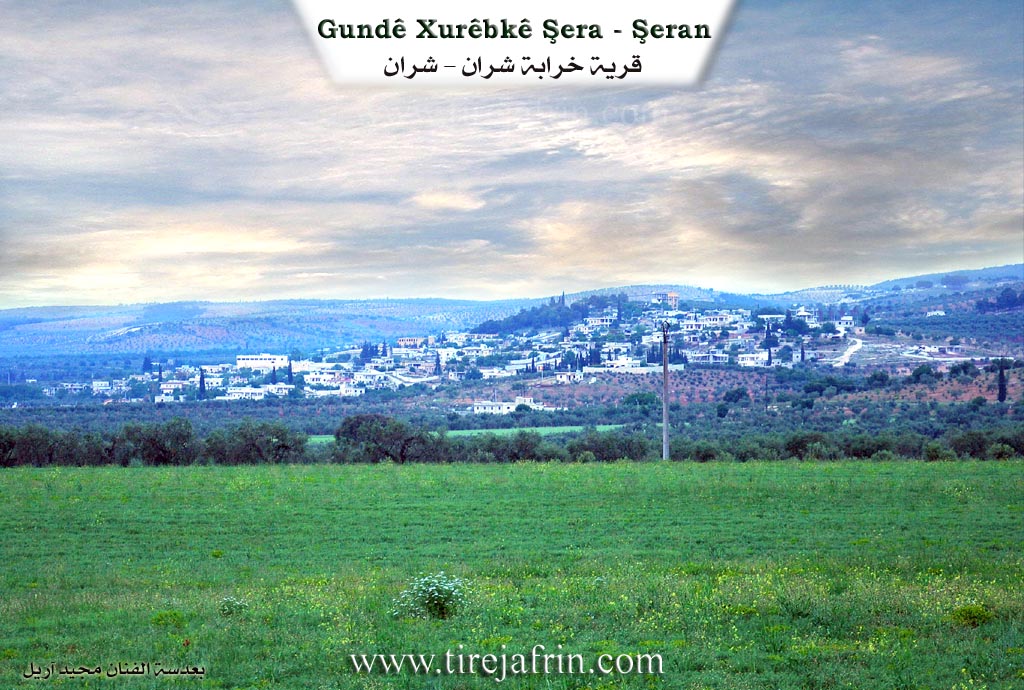
Xirab Şera is an old archaeological site. It is currently a large village and constitutes the southern section of the town of Şeran on the western slope of a limestone plateau. The village has expanded and become an important part of the town of Şeran.
According to the book Efrîn... Her River and Her Green Hills: Xirab Şera is a village in Çiyayê Kurmênc following the Şeran district, Efrîn region, Heleb governorate (4085 inhabitants). It is a large village situated on a mountainous rise and between two mountains, separated by a deep valley extending from the east toward the west which passes through the center of the village.
It is bordered to the north by a slope and a valley planted with olive trees and some orchards, and the town of Şeran which is close by at a distance of 200 meters. To the south, it is bordered by a valley and a mountain chain planted with olive trees and vines, and the village of Metînlê. To the east, there is a mountain rise and a rugged valley planted with forest trees and olives, along with the village of Qetme and the village of Sinkerlî. To the west, there is a wide and fertile plain planted with grains, olive trees, and orchards, along with the village of Kûbelik, the village of Xelûbî Kebîr, and the Riya Meydankê-Bilbil-Kefer Cenê (Meydankê-Bilbil-Kefer Cenê road).
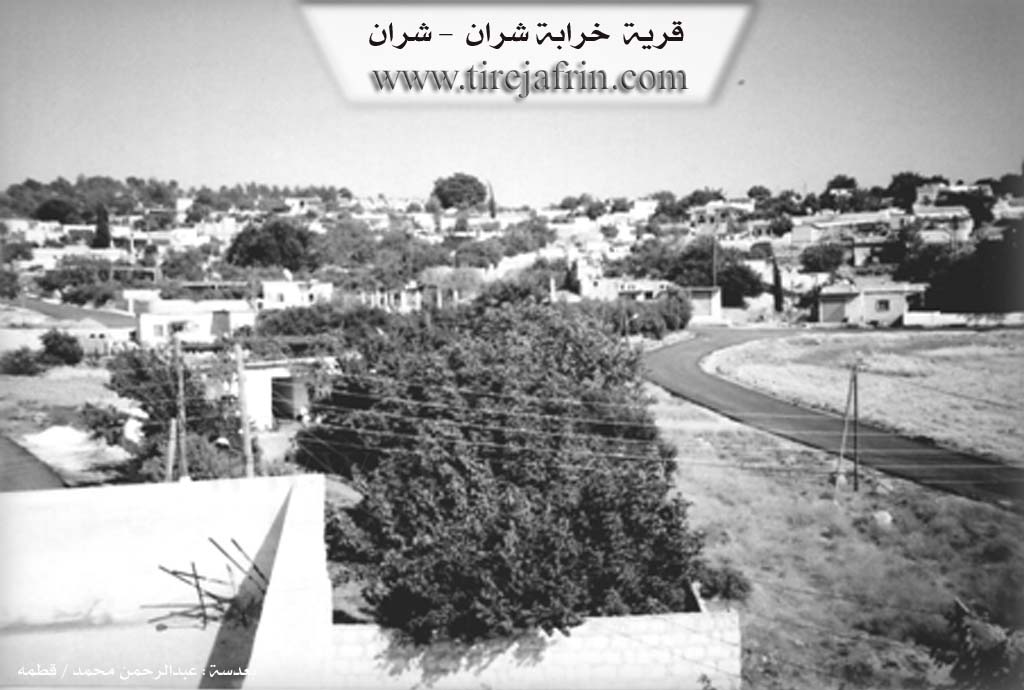
The number of its houses reaches approximately 300 houses, and the age of the village is about 700 years. Its old houses are made of stone and mud with flat wooden roofs, while the modern ones are cement and stone, which have spread westward and southward as far as the valley of Şeran. It is one of the old villages in the Şeran district of the Efrîn region, evidenced by the presence of caves and old grottos in the center of the village.
An electricity network and state-owned drinking water are available, and a paved road passes through its center to several neighboring villages. It contains a primary and preparatory school and an old mosque. It belongs to the municipality of Şeran. It has modern olive presses, and there are very old residential houses as well as three modern villas belonging to Menan Axa Celûsî and Elî Celûsî.
The residents of the village work in the cultivation of olives, vines, grains, walnuts, almonds, and some fruit trees, as well as sheep rearing. There is a telephone center taken from the Şeran center, and several streets are paved. There are also some craft shops such as car repair and blacksmithing. Additionally, there is a Qews el-Nesr (Arch of Victory) at the entrance of the village from the southern side of the town of Xirab Şera.
Among its most important families are: Menan and Ehmed Elî Axa el-Celûsî (Celûsî), Hemdûş, Xelbaş, Sebeb, and Dûdqî. Among the sons of the village are degree holders and artists: PhD in Civil Engineering Engineer Fehmî Ebdo, Sculptor Mihemed Xêr Cefer, and Plastic Artist Ciwan Cefer.
The mukhtar of the village: Cemal Cabû.
Sources of Information:
- Book: جبل الكرد (عفرين) دراسة جغرافية Çiyayê Kurmênc (Efrîn): A Geographical Study by د. محمد عبدو علي Dr. Mihemed Ebdo Elî.
- Book: عفرين .... نهرها وروابيها الخضراء Efrîn... Her River and Her Green Hills by عبدالرحمن محمد Ebdulrehman Mihemed from the village of Qetme.
- Studies of Navenda Tirej Soft / Ebdulrehman Hacî Osman.
- Some residents of the villages.
Preparation and Execution: Manager of the Tirej Efrîn site: Ebdulrehman Hacî Osman 20/12/2013
II. Summary of Xirabî Şera from Afrin 366
Source: https://www.youtube.com/watch?v=8UVm63ThW_8
The documentary provides a detailed visual and oral account of the village of Xerabê Şehra, situated in the Afrin region. The settlement is defined by its substantial size and architectural solidity. Unlike the neighboring village of Sînka, which the presenters describe as small, Xerabê Şehra is characterized as a large settlement resembling a city. Local elders and the host confirm that the village contains approximately 400 households. The architecture is a point of pride for the residents, with structures built from stone (hacer) that was reportedly brought from the direction of Heleb. One resident remarks that the stones in the village are a thousand years old, suggesting a deep historical presence, even if a specific founding date for the current settlement is not provided.
The social structure of Xerabê Şehra is composed of several distinct families identified during the tour. The presenters visit or reference the homes of Mala Ehmed Neccar and Mala Fewzî Hisên, where they stop for coffee and rest. During a conversation with an elder, the specific lineage of Mala Mihemedê Ke'to is clarified when the host inquires about the Neccar family. As the camera moves through the streets, the host points out the properties of Mala Arif and Mala Hebo. Additionally, a crew member is heard asking for directions to Mala Şêxa, indicating the presence of this family within the community. An elder notes that while the physical village remains large, the population has decreased due to migration, stating that many have left the area.
The geography of the village includes specific named landmarks and sacred sites. The host identifies a location known as Mirîk, which appears to be a small spring or water source near the village entrance. On the higher ground (alî jor), there is a site referred to as Mêr, which serves as a religious or spiritual landmark for the community. The village is also noted for its ancient courtyards (hewşê kevnar) and lush natural environment. To cope with infrastructure challenges, the village utilizes solar panels (lewh şemsî) to generate electricity for the households. The documentary team concludes their tour of Xerabê Şehra with plans to proceed to the village of Elqê, highlighting the interconnected nature of these rural settlements in the region.
Transcriptions and Subtitles
| Source | Video | Subtitles | Transcript |
|---|---|---|---|
| Afrin 366 1 | Watch Video | Download SRT | View Transcript |
V. Links
- Tirej Afrin:
https://www.tirejafrin.com/site/kura%20afrin%20%20sheran%20-%20xirabi%20shra.htm - Jawlat:
https://www.youtube.com/watch?v=sPYGZaewJtw - Video:
https://www.youtube.com/watch?v=VIRmQfNCsVk (no longer available) - Link:
https://www.youtube.com/watch?v=wKCPz1scbjo (no longer available) - Link:
https://www.youtube.com/watch?v=njfDLJQh6qA - Link:
https://www.youtube.com/watch?v=3WEDp3h_-Go - Link:
https://www.youtube.com/watch?v=i5uSBAyukhU - Local FB page:
https://www.facebook.com/sharranvillage - Afrin 366:
https://www.youtube.com/watch?v=8UVm63ThW_8