General Information
Nahiya (Subdistrict)
Efrîn
Also Known As
Basufan, Basûfanê, باصوفان
Tribes
Ereb, Nabo, Selmû, Xaltî
Families, Clans, etc.
Feqîr, Mala Mîro, Mala Qib, Mala Şêx Mîr, Sêla
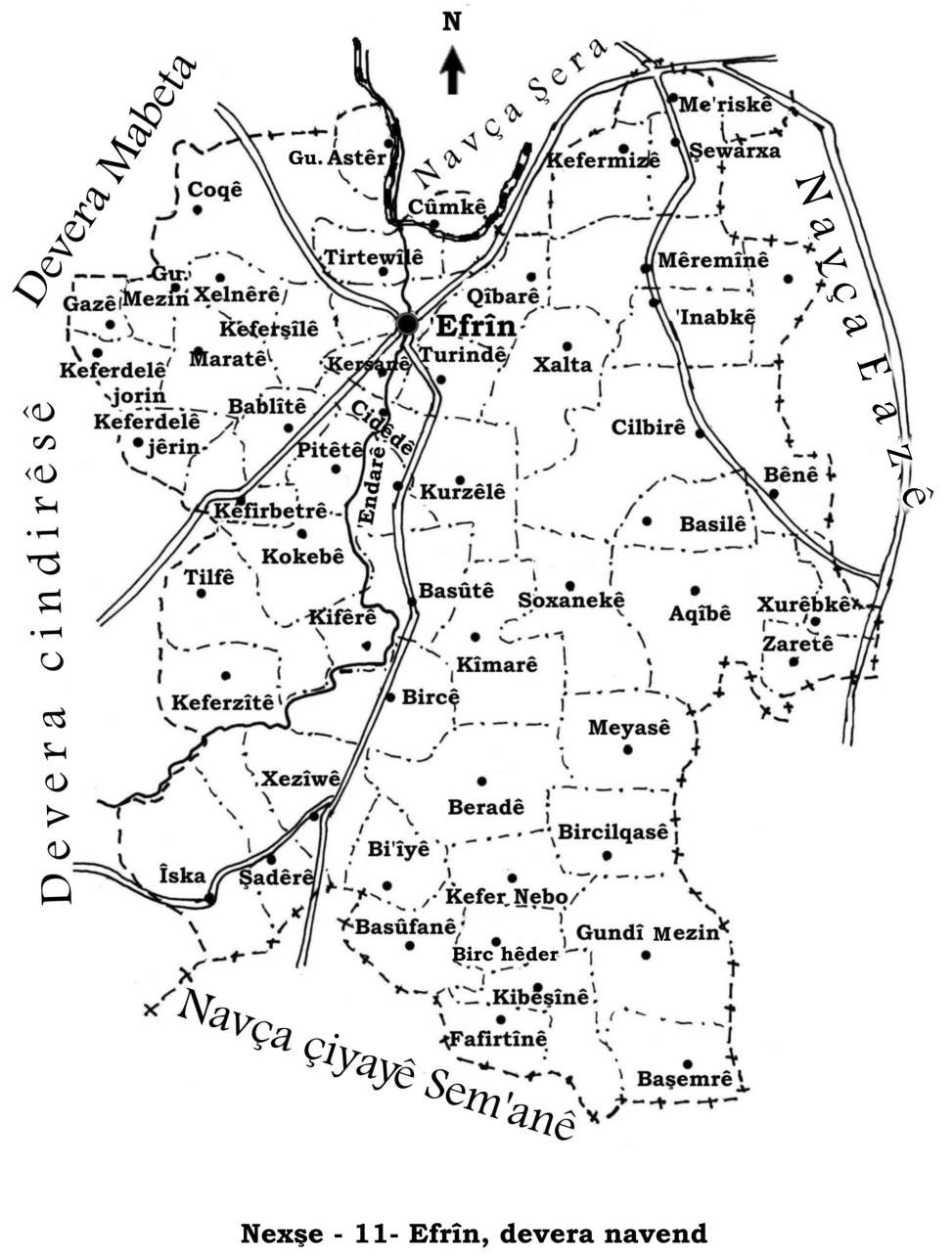
Photos
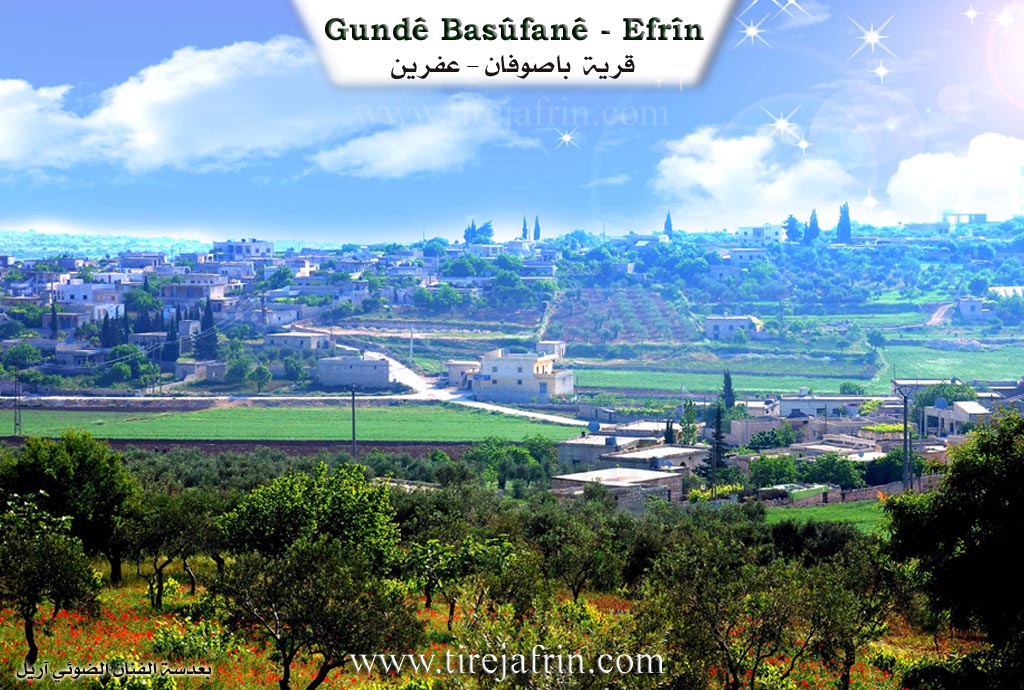
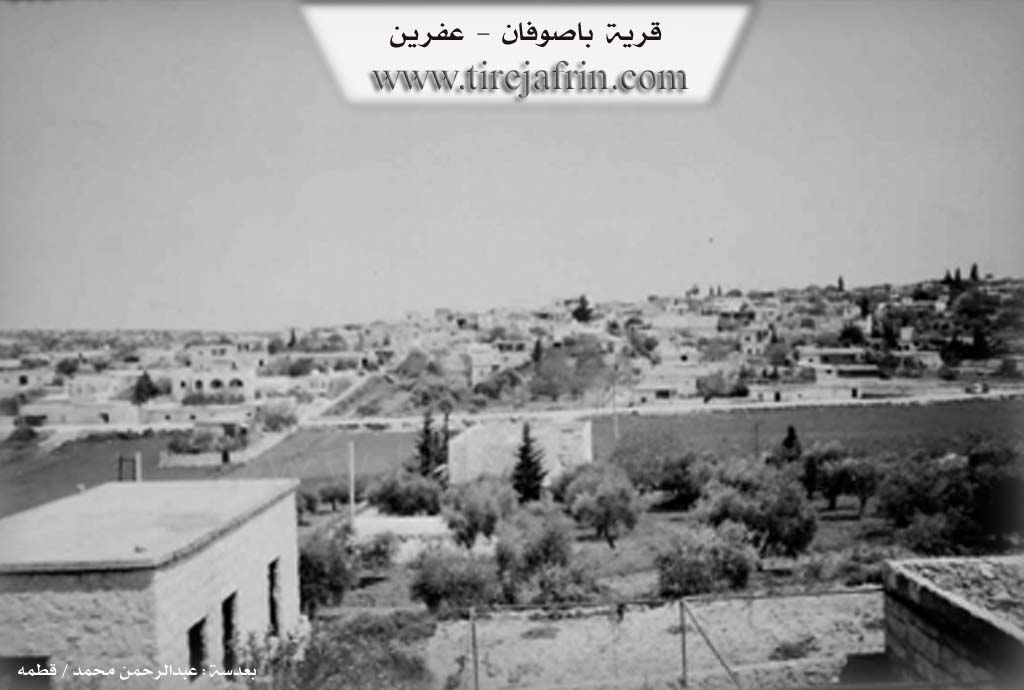
Basic Information about Basûfanê
Source: Tirej Afrin
Etymology: Various theories exist: 'House of the Priest' (Sofan); 'House of Rain' (Aramaic: Bet Şufna); 'House of Soap/Sailor'; or 'With the Sufis' (Ba + sofiyan), referring to Yezidi mystics. Also linked to the village of Bazîwan in Xaltan.
Foundation Date/Period: Approximately 500 years ago
Hills: Çiyayê Lêlûn, Çiyayê Sem‘an
Shrines: Ziyareta Şêx Elî
Wells: Bîra Zûq el-Kebîr
Other Landmarks: Wadiyê Xerab
Summaries
I. Summary from TirejAfrin Site (English) of Basûfanê
Source: https://www.tirejafrin.com/site/kura%20afrin%20markaz-basufan.htm
The following details appear in the book جبل الكرد (عفرين) دراسة جغرافية Çiyayê Kurmênc (Efrîn): A Geographical Study by د. محمد عبدو علي Dr. Mihemed Ebdo Elî:
Basfan / Basûfan
(2059 inhabitants - 435 hectares - 30 km from center - 605 m altitude)
It is said that "Sofan" means "priest" (a Christian clergyman), and the full name means "House of the Priest." However, Al-Asadi, quoting Father Shalhat, states that it is from Aramaic: Bet Şufna, meaning "House of Rain/Drops" (Vol 2, p. 32). Khoury Barsoum (p. 58) says it means "The Limit or The End," but in his opinion, the name means "House of the Sailor" or "House of Soap" (a place for soap manufacturing) due to the presence of olive trees around it.
The narrative of its residents states that some mystics (Sufis) followers of the Êzîdî religion used to live at the village site. Residents of neighboring villages would visit them hoping for the healing of their sick through prayers, saying at the time: "Let us go to the Sufis" (Ba + sofiyan). The two words were then merged to become the name of the place, Basofiyan and Basofan. Additionally, Şêx Elî, one of the Êzîdî sheikhs, used to say that its origin is from Bazîwan, which is the name of a village in the Xaltan region in northern Kurdistan, from where its first Êzîdî inhabitants came. The name was corrupted over time to Basûfan. I believe this opinion does not contradict the residents' narrative regarding the residence of mystics there; perhaps they were from that village or were arrivals from their original region, Xaltan.
It is a large village located on the surface of Çiyayê Lêlûn. It contains archaeological remains of buildings, a market, church walls, tombs, archaeological cisterns carved into the rock, and old presses for oils and wines. Its inhabitants are Êzîdî Kurds, and the shrine of Şêx Elî is located in its center.
The following details appear in the book عفرين .... نهرها وروابيها الخضراء Efrîn... Her River and Her Green Hills by the writer عبدالرحمن محمد Ebdulrehman Mihemed from the village of Qetme:
Basûfan
This is a village in Çiyayê Lêlûn and Çiyayê Sem‘an, administratively belonging to the central sub-district and district of Efrîn, Aleppo Governorate. It is a village located on the surface of a limestone plateau overlooking two valleys to its north and south, which meet to its northwest to form Wadiyê Xerab (Valley of Ruin). To its east and southeast lie small plains. Its soil is clay-heavy with some protruding limestone rocks. It is 19 km south of Efrîn.
Its settlement is ancient, evidenced by the presence of remains of buildings, a market, church walls, tombs, and cisterns carved into the rock, as well as presses for oils and wines.
It is bordered to the north by a valley, a watercourse, a rugged mountain chain of rocks and forest trees, and the villages of Baê and Brad. To the south, there is a rugged mountain chain, the farm of Burc Silêman, and Keferlab. To the west lies the Çiyayê Sem‘an chain, the lower depression of the mountain, the Efrîn valley, the Cûme region, and the village of Xezawiyê. To the east, there is a mountain chain, two watercourses, a series of rugged rocks, and the villages of Burc Heyder and Kefernabo.
The number of its houses is approximately 400, and its age is about 500 years (referring to the current settlement). It is one of the old and beautiful villages at the summit of Çiyayê Lêlûn and Çiyayê Sem‘an. The old village dwellings are made of stone, mud, and wood, while modern houses are made of stone and reinforced concrete.
An electricity network is available, as well as drinking water taken from Bîra Zûq el-Kebîr (Big Zouk well) which belongs to the state. It is connected to the city of Efrîn and Aleppo via Çiyayê Sem‘an by an asphalt road passing through its center. It has a primary and middle school and a telephone center. In the eastern side of the village center, there are some Roman antiquities consisting of remains of church walls, palaces, archaeological columns, and the shrine of Ziyareta Şêx Elî close to the school.
Its residents work in the cultivation of grains and olives on an area of 435 hectares on a small patch of land interspersed with stones and rocks, alongside raising sheep and cows and some poultry farms on the northern and western sides of the village. There is a modern olive press in the village.
Village Mukhtar: Ednan Cumce Seyf el-Dîn
Sources:
- Book: جبل الكرد (عفرين) دراسة جغرافية Çiyayê Kurmênc (Efrîn): A Geographical Study by د. محمد عبدو علي Dr. Mihemed Ebdo Elî.
- Book: عفرين .... نهرها وروابيها الخضراء Efrîn... Her River and Her Green Hills by عبدالرحمن محمد Ebdulrehman Mihemed from the village of Qetme.
Preparation and Execution:
- Manager of Navenda Tirej Efrîn: Ebdulrehman Hacî Osman
- 20/12/2013
II. Summary of Basûfanê from Afrin 366
Source: https://www.youtube.com/watch?v=hNf4ftYGb7M
The documentary explores the village of Basîfan, a picturesque settlement located in the Efrîn region. Specifically, the village is situated in Çiyayê Şêrawa, a mountainous area that locals also refer to as Çiyayê Lêlûn. The filming takes place following a request from a man named Edîb Yûsif. A local elder named Abu Aram provides a comprehensive overview of the history and social fabric of the community.
According to Abu Aram, Basîfan serves as the central hub for the surrounding Çiyayê Lêlûn region. If residents of nearby villages such as Birc Heyder, Kebêşîn, Fafertîn, or Bircika ever need supplies, they come to Basîfan. The village has a deep historical foundation. Right in the middle of the settlement lie the ruins of a Kele, an ancient castle that dates back to the eras of Roma and Bîzantiya. The host tours these historical structures, admiring the stone carvings and domed rooms that still stand despite being in ruins.
The social and religious identity of Basîfan is entirely Êzîdî. Abu Aram proudly describes the Êzîdî faith as an ancient religion of goodness and peace, connecting its origins to the ancient empires of Babîliya, Mîdiya, and Sumeriya. The village contains approximately two hundred and fifty houses. The local population is organized into several main tribes and affiliated families. The primary tribes are Nabo, Selmû, and Ereb. Smaller families, such as Feqîr and Sêla, are socially connected to these larger tribal groups.
Within the Êzîdî religious structure, these groups belong to distinct lineages. The Nabo tribe is part of the Şêxmend lineage. Both the Selmû and Ereb tribes belong to the Nasirdîn lineage. Meanwhile, the Feqîr family is part of the Şêxûbekr lineage.
As the host walks through the village, he views the large courtyards belonging to residents like Şikrî Abu Rêzan and Kemal. Later in the documentary, the men engage in a casual conversation about health, mentioning a local man named Selahattîn and discussing herbal remedies for illnesses. There is also a brief historical discussion where locals like Husên and Evdal are mentioned in the context of older generations who witnessed historical events involving people from Rûsya. The villagers note that these visitors spoke fluent Kurdish.
The video concludes with a visit to the local cemetery, exploring a section known as Pîrkatiya. The cameraman pays respects at the graves of several individuals, including Yûsiv Nebo Sadiq, Elî, and Sidîq. They observe that some of the older gravestones bear a star symbol associated with the Rûs, reflecting the complex historical layers of Basîfan.
II. Summary of Basûfanê from Ax û Welat
Source: https://www.youtube.com/watch?v=KR31yqmKfws
The village of Basûfan is a historic Êzîdî settlement located in the Şêrawa district south of the Efrîn canton. The area has an ancient history supposedly dating back to 700 to 800 BC and encompasses the eras of the Mîtan and Horî and Xaltî emirates. According to the documentary, the region once hosted 85 Êzîdî villages during the 1930s, populated predominantly by the Xaltî tribe, including nearby settlements like Xalta, Qermîtliq, Maratê, and Kebeşîn. The name Basûfan, alternatively pronounced Bazo Fan, is believed to derive from the local word for a strong storm or wind, a reference to its elevated geography facing the Mediterranean Sea. Another local tradition attributes the name to an ancient Sufi healer who treated residents.
Socially, the village consists of 360 households and approximately 3500 residents. Uniquely, the entire population of Basûfan belongs to the Şêx religious class of the Êzîdî faith. This class is further divided into three distinct lineages: Nasir Dîn, Şêxmend, and Şêxbekir. While the villagers historically sustained themselves through wheat and barley farming alongside livestock trading and olive cultivation, many young people have recently migrated to Europe, specifically Germany and Greece.
Basûfan is renowned for its vast network of over 100 ancient caves. Elder residents recall that generations of villagers lived inside these caves until around the time of the First World War. Specific families, such as Mala Qib, Mala Şêx Mîr, and Mala Mîro, maintained cave dwellings where the sick were brought for spiritual healing. One prominent cave featured a healing column called Ocax, where locals would tie cloths and pray for miraculous cures for ailments and blindness. The village also houses historic Christian ruins, notably Dêra Elkîdîs Foqas, constructed around 492 AD. Inscriptions in Syriac commemorate figures like Mar Dîmnyanos and Fokas.
The documentary films the village during the sacred fasting days preceding the Êzîdî festival of Êzî. A community teacher named Mahir leads a local religious academy, teaching youth to recite sacred texts like Qewlê Naserdîn. Due to the tragic massacres of Êzîdî people in Şengal and the heavy fighting in Kobanê, community leader Silêman Cefer explains that festive celebrations were canceled in favor of somber prayers. On the day of the feast, villagers gather at the shrine of Şêx Elî to perform circumambulations. Led by Şêx Hesen, the community recites prayers invoking divine figures such as Şêşims, Fexredîn, Şêxadî, and Tawisî Melek. Following these rituals, the villagers walk together to the cemetery to honor their ancestors, maintaining their deep spiritual roots in the foothills of Lêlûn.
Transcriptions and Subtitles
| Source | Video | Subtitles | Transcript |
|---|---|---|---|
| Afrin 366 1 | Watch Video | Download SRT | View Transcript |
| Ax û Welat 1 | Watch Video | Download SRT | View Transcript |
Foundation/Origin Information of Basûfanê
Its inhabitants are from the Yazidi Kurds. According to a narrative from its inhabitants, some Sufis from followers of the Yazidi religion used to live in the location of the village. Another narrative from a Yazidi sheikh states that its origin is from "Baziwan" which is the name of a village in the Khalistan region in northern Kurdistan, from which came the first inhabitants of its Yazidi inhabitants.
Source: TirejAfrin Site
Possible Village Name Meaning of Basûfanê
Multiple theories: 1) "Sofan" means "priest" and the complete name means "house of the priest". 2) From Aramaic: Beit Shofna: house of the horn. 3) From Aramaic: "the limit or the end". 4) "house of the sailor or house of soap makers". 5) From a local narrative: people would say "let us go to the Sufis" (sofiyan Ba), which merged to become Basofan. 6) From a Yazidi sheikh: its origin is from "Baziwan", a village name that was corrupted over time to Basufan.
Source: TirejAfrin Site