General Information
Nahiya (Subdistrict)
Bilbilê
Also Known As
Berkaşê, Berkesheh, Berkeshli, Berkêş, بركشة, بركشلي, بركيشه
Tribes
Amkan, Omka, Omkan, Qerebaba
Families, Clans, etc.
'Emwî, Avdî Şêşê, Besûş Gube, Elîf, Elîkê, Emerê Elî, Family of Ebdo Mihemed, Girîn, Ibik, Me'mik, Seydik, Xelîlaka, Şeşê, Şêşê
Photos
Basic Information about Berkaşê
Source: Ax û Welat
Etymology: Named because the village is located near the slope of the mountain (nîzîkaşê çiyê)
Foundation Date/Period: 450 years ago
Hills: çiyayê Kûtê
Summaries
I. Summary from TirejAfrin Site (English) of Berkaşê
Source: https://www.tirejafrin.com/site/kura%20afrin%20%20%20bilbile%20-%20Barkshle.htm
Berkaş, Berkeşlî, Berkeşe / 427 inhabitants - 700m /
Berkaşî: This means "at the slope" in Kurdish (ber + kaş), which is a true attribute of the village's location. As for Xûrî Bersûm, he says that it is an Aramaic name meaning "House of Disturbances," or from Syriac meaning "The secluded ones knelt," or "Blessed the ulcer or the cave" (p. 69). All of this is contrary to the truth.
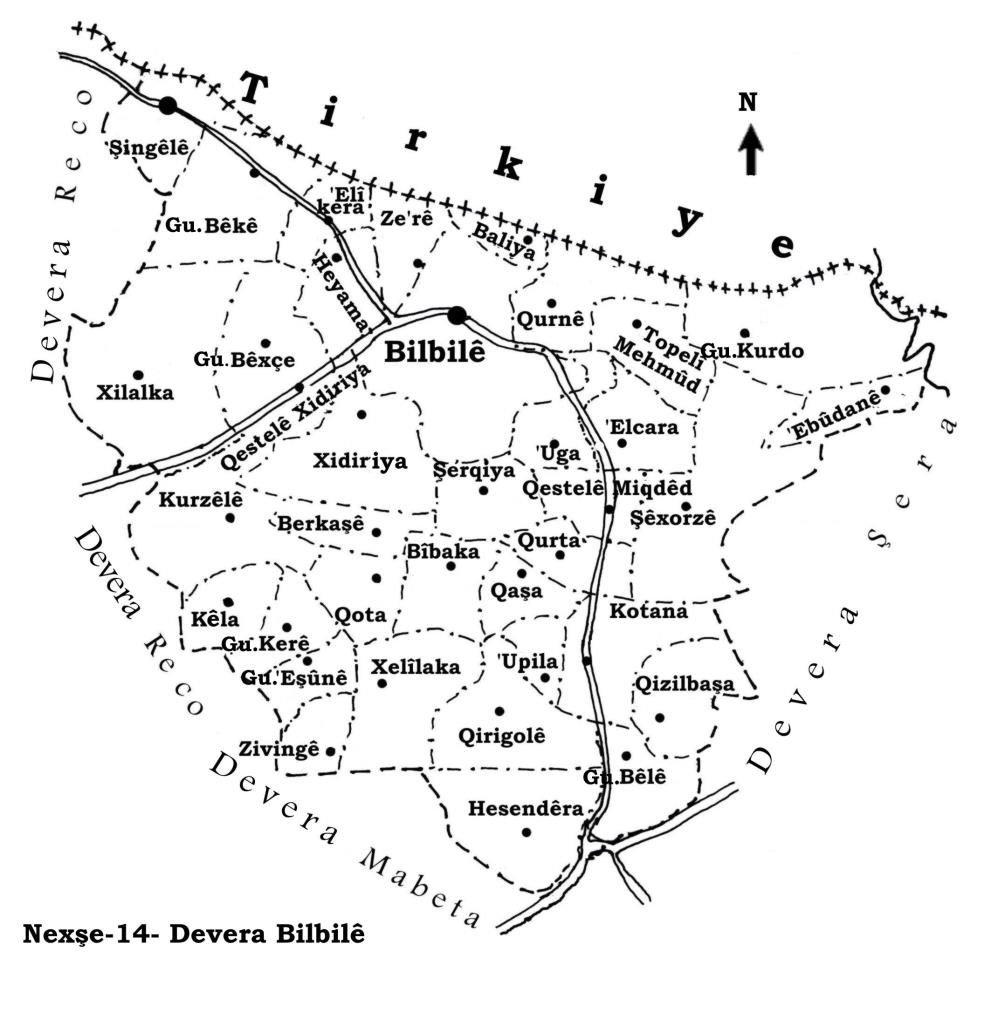
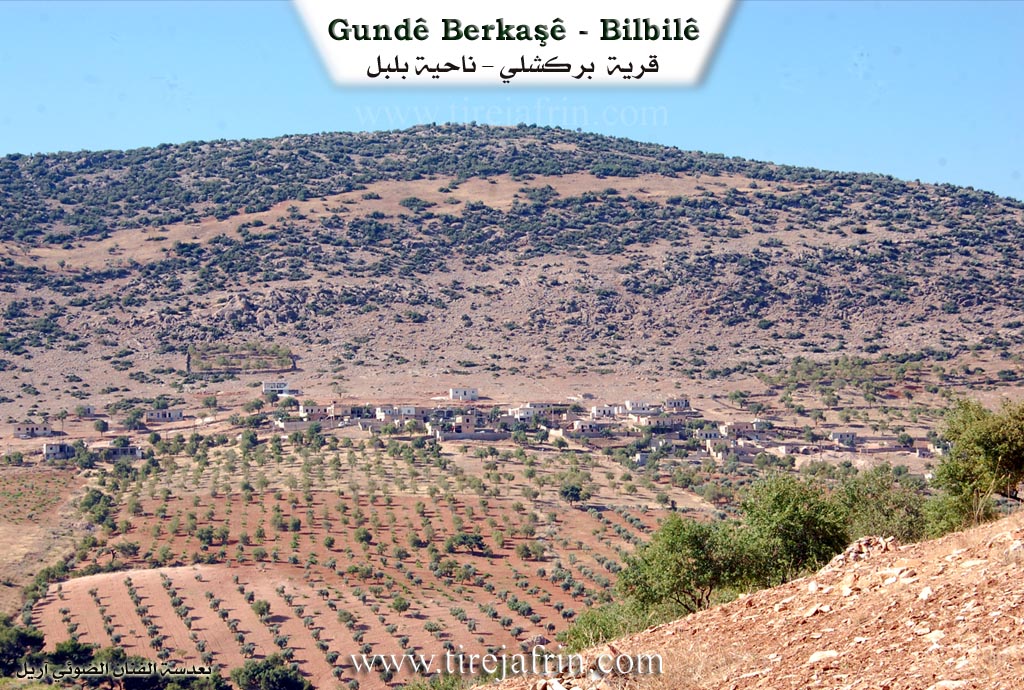
It is located on the steep southern slope of Çiyayê Simaq (Sumac Mountain), and it is about 4km away from the village of Şerqiyan in the east. Its location is not visible, as if it were carefully hidden.
It is stated in the book Efrîn... Her River and Her Green Hills: Berkeşlî is a farm in Çiyayê Kurmênc belonging to the Bilbil district, Efrîn area, Heleb governorate. It is a small farm located on the steep middle southern slope of the limestone Çiyayê Simaq, in the northern part of the Heleb plateau. Flood streams descend with the slope towards the south. It is 4km away from the village of Şerqiyan towards the southwest, and 20km from the town of Bilbil towards the southwest.
It is bordered to the north by a high and rugged mountain chain and the villages of Dûbîra and Xidriyan; to the south by a deep flood valley and the village of Qutan at a distance of 1km; to the west by a pass and a flood valley between two mountainous heights planted with olive trees and the village of Kurzêlê; and to the east by a deep flood valley and the village of Bêk Oba.
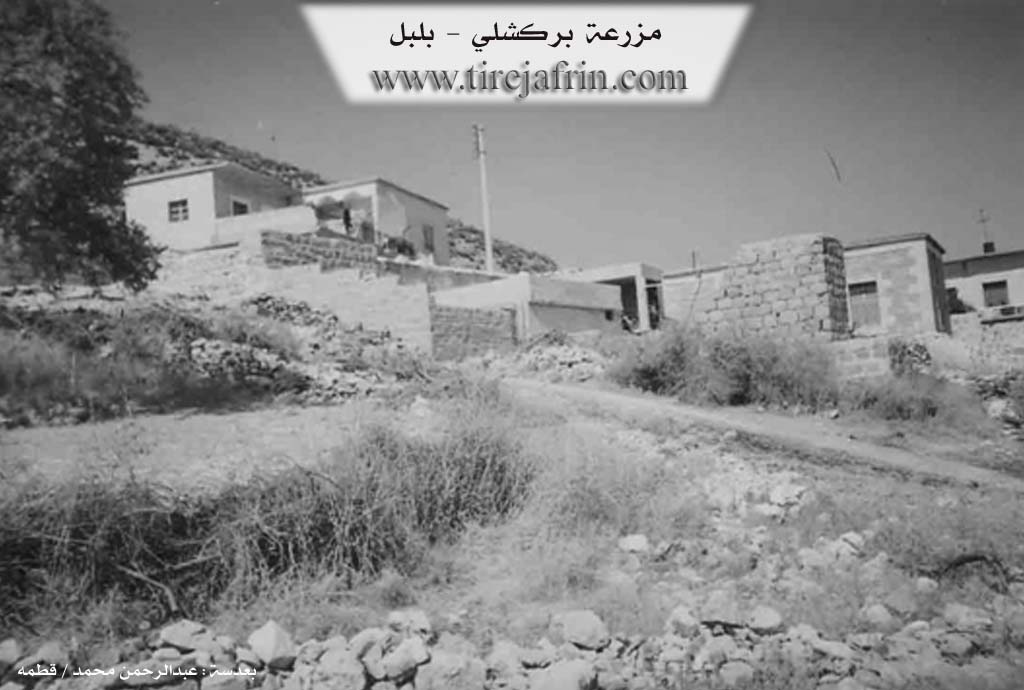
Its lands are mountainous, rugged, and poor from an economic standpoint. Most of its inhabitants have migrated to the cities, to Heleb and Efrîn, in search of a livelihood. The number of its houses is about 15, and its age is approximately 250 years. Its old houses are made of stone and mud with flat wooden roofs, while the modern ones are made of cement blocks. An electricity network and a modern olive press are available. The village drinks from artesian wells recently dug or from cisterns in which rainwater is collected.
The residents work in rain-fed agriculture: olives, vines, and grains. Due to the limited cultivated areas, they are interested in raising sheep and goats. The road to the village is mountainous, earthen, and unpaved. Among the most important people of the village is the family of the artist and singer Ebdo Mihemed.
Village Mukhtar: Cemîl Henan Cefer
Sources of Information:
- Book: جبل الكرد (عفرين) دراسة جغرافية Çiyayê Kurmênc (Efrîn): A Geographical Study by د. محمد عبدو علي Dr. Mihemed Ebdo Elî.
- Book: عفرين .... نهرها وروابيها الخضراء Efrîn... Her River and Her Green Hills by عبدالرحمن محمد Ebdulrehman Mihemed from the village of Qetme.
- Studies of Navenda Tirej Soft / Ebdulrehman Hacî Osman.
- Some residents of the villages.
Preparation and Execution: Manager of the Tirej Efrîn website: Ebdulrehman Hacî Osman 20/12/2013
II. Summary of Berkaşê from Ax û Welat
Source: https://www.youtube.com/watch?v=J8tH7xWQJjc
The village of Berkaşê, located in the Afrin region, is highlighted in this documentary not through its physical monuments or ancient ruins, but through the living memory of its residents, specifically regarding the cultural and political resistance of the 1990s. The primary historical narrative focuses on the role of village residents in the Kurdish theater and arts movement during a period of intense pressure from the Syrian government.
Two notable residents, Ehmed (often referred to as Apê Ehmed) and Menan Osman 'Emwî, provide a detailed oral history of this era. Ehmed is a veteran stage actor who began his theatrical work around 1976, continuing through the early 1990s. The transcript reveals that Berkaşê was home to individuals deeply involved in regional artistic troupes, specifically Koma Berxwedan and Koma Agirî. These groups were part of a broader movement (including Koma Engîzekê) that used folklore and theater to preserve Kurdish identity and articulate political resistance.
The historical significance of the village's residents lies in their dedication to these cultural activities despite severe state oppression. Ehmed recounts the years between 1990 and 1995 as a particularly volatile period where security forces frequently targeted their performances. The plays were typically performed during Newroz celebrations at various regional locations, including Binê Seringekê, the area around the Kelê (fortress), and the hills of Cindirêsê. The content of these plays was often allegorical or satirical; Ehmed describes playing a comedic but politically charged character named Inxîfat (or Imiş), a "kuşkar" (fuel/dung collector), to mock the absurdity of the political situation.
The narrative also details the risks involved. Ehmed mentions fellow performers like Berezanî from Şêxûrzê, Menaf, and 'Ezdîn from Serîncekê. He recounts a specific harrowing event involving a member named Ebû Selam, who broke his leg while fleeing from security agents. The troupe managed to rescue him from capture, highlighting the solidarity and danger inherent in their work. The transcript underscores that for the people of Berkaşê, theater was not merely entertainment but a form of "berxwedan" (resistance) against policies represented by figures they associated with "Kemalism" and state intelligence. Today, elders like Ehmed and Menan Osman 'Emwî are viewed as custodians of this difficult history, linking the struggles of the 1990s to the contemporary political landscape of the region.
II. Summary of Berkaşê from Ax û Welat 2
Source: https://www.youtube.com/watch?v=iO71bGoP6i8
The village of Berkêşê is a historic settlement located in the Bilbil district of the Efrîn region (also known as Çiyayê Kurmênc). Geographically, it is situated on çiyayê Kûtê, approximately 35 kilometers southwest of the town of Bilbil and 35 kilometers north of the city of Efrîn. The village’s name is derived from its topography, specifically its location near the slope (ber kêş) of the mountain. According to local accounts, Berkêşê was founded approximately 450 years ago. The social structure of the village is notably homogenous; the entire population descends from a single family lineage belonging to the Amkan tribe.
The documentary focuses primarily on the recollections of a local resident named Ehmed, a cobbler who adopts the comedic persona and nickname Emiş. Ehmed explains that he uses this persona to endear himself to the community and hide his struggles. He is a father to two sons, Mihemed and Enter. Through a conversation with an interviewer and a fellow villager named Menan Osman, Ehmed recounts the vibrant but difficult history of Kurdish cultural resistance in the region during the 1990s.
Ehmed details his involvement in local theater and folklore groups, specifically mentioning Koma Berxwedan, Koma Agirî, and Koma Engîzek. These groups were active in preserving culture through plays and performances during Newroz celebrations and other gatherings. He describes performing in various locations in the region, such as Binê Serîncekê, near Kelê, and in Cindirêsê. The theater sketches often carried political subtexts, including critiques of the policies of Mistefa Kemal and the concept of betrayal, featuring characters like one played by an actor named Berezanî from Şêxûrzê.
However, Ehmed emphasizes the severe repression these cultural activists faced between 1990 and 1995. He describes how state security forces subjected them to intense scrutiny and torture, forcing them to cease their theatrical activities by the mid-90s to ensure their survival. Despite these past hardships, the villagers express pride in their cultural heritage and voice strong support for contemporary political and security forces in the region, including the YPG, YPJ, and Asayîş. The narrative underscores the resilience of the Berkêşê community, linking their historical roots on çiyayê Kûtê to a modern identity forged through cultural struggle.
II. Summary of Berkaşê from Ax û Welat 3
Source: https://www.youtube.com/watch?v=zBiZO9xtqgU
The village of Berkaşê is a historic settlement located in the Bilbil district of the Efrîn region. Situated approximately 35 kilometers north of the city of Efrîn, the village rests at the foot of Çiyayê Kûtê (also referred to as Çiyayê Gûtiyan, linking it to the ancient Gutian people). The name Berkaşê is derived from its geographical position; speakers explain it means "below the slope" ("Ber kaş" or "Ber kêş") due to its location beneath the mountain.
The village was founded approximately 450 years ago. According to local oral history, the first family to settle there was Elîf. The primary lineage of the village traces back to a founding ancestor named Me'mik, who arrived with his four sons: Elîkê, Me'mik, Seydik, and Ibik. These sons established the core families of the village, who predominantly belong to the Amkan (or Omka) tribe. Later in the village's history, the Şêşê family (also referred to as Mala Şêşê or Avdî Şêşê) migrated to Berkaşê from Qerebaba. An elder, Mihemed Me'mû, recounts that the name Şêşê originated from an ancestor named Hemê who was born with six fingers ("şeş bêç") on his hands and feet.
Berkaşê is characterized by a lack of natural springs (kanî). Consequently, the residents historically relied on rainwater harvesting, with every house possessing a cistern (sarnic) to store water for the year. Agriculture is the primary livelihood, with villagers cultivating olives, grapes, and almonds. The village also contains a historical landmark: the Guvaşgeha kevnar ya tîrî (an ancient grape press), which was constructed around 1930. The surrounding geography includes the valley of Geliyê Sor and the ridge known as Gaza Kewê. To the west lies Zêwê and Bîbaka, while Qûta lies to the south.
The village has a strong cultural and artistic reputation. Mala Şêşê is particularly renowned for producing musicians and singers. During the documentary, members of this family, including Hesen Mihemed and Reşîd Mihemed, discuss their musical heritage, noting the influence of historical regional figures like Elî Rehmetî, Cemîl Hûro, and Nûrî Şêxo. The village is also home to theater enthusiasts like Menanê Osman, who performed comedic skits and was involved with cultural groups like Koma Berxwedan. Despite the lack of a local school, forcing children to walk to the nearby village of Qûta for education, the village boasts a high level of educational attainment, with many doctors and engineers among its population. Residents also maintain traditional practices, such as gathering wild herbs like Tûlik, Çaqir, Zenter, and Bîkmazova from the surrounding hills during spring.
II. Summary of Berkaşê from Ax û Welat 4
Source: https://www.youtube.com/watch?v=_hVQS_nEcjI
The documentary explores the historical and cultural landscape of Berkaşê, a village situated on Kûtiya mountain in the Bilbilê district of the Efrîn region. Located thirty five kilometers north of Efrîn city, the village is built on a steep incline near the towering Hawar mountain. Its name derives from the phrase Ber Kaş, which translates to under the slope, accurately describing its geographical placement at the foot of Qotê mountain.
Berkaşê was founded approximately 450 years ago. According to local elders, the first settler was a man named Mehmik from the Amkan or Omkan tribe. He established the village and had four sons named Elîk, Mehmik, Seydik, and Îbik, who formed the foundational lineages. Over time, other families arrived, including the Şeşê family who originally came from Qerababa. The Şeşê family earned their unique name because their ancestor had six toes. While many families like the Girîn, Emerê Elî, and Xelîlaka remained in the village, members of the Mala Şeşê eventually migrated to places like Heleb and Libnan seeking better economic opportunities.
Surrounded by prominent geographic landmarks, Berkaşê is bordered by Qotê mountain, Kurzelê, and Uqadîça to the north. To the east lie olive groves and Bîbaka, while to the south and west are Geliyê Sor, Gaza Kewa, and Qota. Despite having no natural springs in the village itself forcing residents to rely entirely on cisterns for rainwater collection the village is agriculturally rich. Residents cultivate olives, almonds, and vineyards, and women forage for wild seasonal herbs like Tûlik and Çaqir.
Culturally, Berkaşê is renowned for its deep roots in arts, traditional singing known as dengbêjî, and theater. During the 1990s, villagers actively participated in clandestine Kurdish theater groups like Berxwedan and Agirî. One prominent resident, Menan Osman, shares stories of performing plays across the region, even under threat of state oppression. The village is also famous for its dengbêj artists, including the elder Mihemed and his sons Ebdû Mihemed, Hesen Mihemed, and Reşîd Mihemed. They preserved local musical traditions, often performing alongside legendary regional singers like Mihemed Elî Tico, Cemîl Horo, and Nûrî Şêxo.
Despite its rich cultural heritage, the village lacks basic infrastructure. There is no local school, so children must walk two kilometers to the neighboring village of Qotê. Nevertheless, Berkaşê boasts a highly educated population, with over a hundred university graduates, including doctors and engineers. The village also honors its martyrs, specifically Şêro Zor, Mistefayê Mezin, and Mistefayê Biçûk. Through their agricultural resilience, community labor like women rhythmically pounding wheat in the village square, and steadfast dedication to Kurdish arts, the people of Berkaşê maintain a vibrant historical legacy.
II. Ax û Walat Book 2
91
BERKAŞÊ
3.4.2017
The village of Berkaşê is on Kotê mountain, 20 km southwest of the town of Bilbilê. It is affiliated with the Bilbilê district of the Efrînê canton. It is located 35 km north of the city of Efrînê.
Because the village is near the slope of the mountain, it was named Berkaşê.
All the people of the village are from one family, from the Amka tribe. The village was built nearly 450 years ago, and the family of Me’mkê Elîfê was the first family to reside in the village.
The village of Berkaşê was built on an ancient site whose history dates back to the Goths, and many traditions bear witness to this fact.
The Şeşê family came from the village of Qere Baba and settled in the village of Berkaşê. This family is famous for the art of minstrelsy and dance
92
is famous, and many artists have emerged from them, including Hesen Mihemed and Ebdo Mihemed.
Heboyê Me’mkê and Umerê Elîko were elders and wise men of the village. All the village's problems were solved through them, and they also protected their village from ill-wishers.
To the north of the village is Kotê mountain, which extends from the village of Kurzêlê to the village of Uga; to the east are olive fields and the village of Bîbaka; to the south are the Sor valley, Gaza Kewa, and the village of Qota; and to the west are the Sor valley and Kotê mountain.
The people of the village make their living primarily from agriculture, like all the surrounding villages, but some families also raise livestock alongside farming. Some young men and men from the village work in various factories in Bilbil and Efrînê.
Nearly 60 houses and around 1100 people live in the village, but due to the lack of services, many people have migrated outside the village.
There are 3 martyrs from the village:
Martyr Şîrazor, Mistefayê Mezin and his brother Mistefayê Biçûk.
The village's commune is named after Martyr Mistefa.
There is no school in the village, and the village children go to school in the village of Qota, which is 2 km away from the village.
93
There is an old grape press in the west of the village. It was built in the 1930s.
According to the number of residents in the village, the literacy rate is good. More than 10 people have graduated from university, including 3 doctors and 4 engineers.
Transcriptions and Subtitles
| Source | Video | Subtitles | Transcript |
|---|---|---|---|
| Ax û Welat 1 | Watch Video | Download SRT | View Transcript |
| Ax û Welat 2 | Watch Video | Download SRT | View Transcript |
| Ax û Welat 3 | Watch Video | Download SRT | View Transcript |
| Ax û Welat 4 | Watch Video | Download SRT | View Transcript |
Foundation/Origin Information of Berkaşê
Among the most important owners of the village is the family of artist and singer (Abdo Mohammed).
Source: TirejAfrin Site
The village was founded by a man named Memik from the Amkan tribe, whose four sons formed the initial community, which later grew with the arrival of other families, such as the Şaşê family from the nearby village of Qere Baba.
Source: Ax û Walat Transcript
Possible Village Name Meaning of Berkaşê
"Berkashi" means "at the slope" in Kurdish. Al-Khoury Barsom says it is an Aramaic name: from the house of disturbances, or from the Syriac "the kneeling retreated," or Bark Al-Karh or the cave.
Source: TirejAfrin Site
The village derives its name from its position "by the slope of the mountain" ("ber kêşê").
Source: Ax û Walat Transcript
V. Links
- Tirej Afrin:
https://www.tirejafrin.com/site/kura%20afrin%20%20%20bilbile%20-%20Barkshle.htm - Ax û Welat:
https://www.youtube.com/watch?v=_hVQS_nEcjI - Ax û Welat:
https://www.youtube.com/watch?v=J8tH7xWQJjc - Ax û Welat:
https://www.youtube.com/watch?v=iO71bGoP6i8 - Ax û Welat:
https://www.youtube.com/watch?v=zBiZO9xtqgU